
Why OWM Exists
Optimized Web Marketing™ (OWM™ – pronounced “Om”) was developed to provide clarity within an increasingly fragmented digital landscape.
As web platforms evolved, so did the language used to describe visibility. Search, social media, artificial intelligence systems, video platforms, audio channels, and web experience design began influencing one another in complex ways. New acronyms emerged to capture specific techniques and environments, yet strategy often remained divided across teams and tools.
OWM was created to formalize a unifying principle: optimization must be coordinated across interconnected visibility systems.
Rather than introduce another isolated methodology, OWM defines a structured framework for aligning brand/entity authority, content architecture, signal distribution, and technical performance across the modern web.
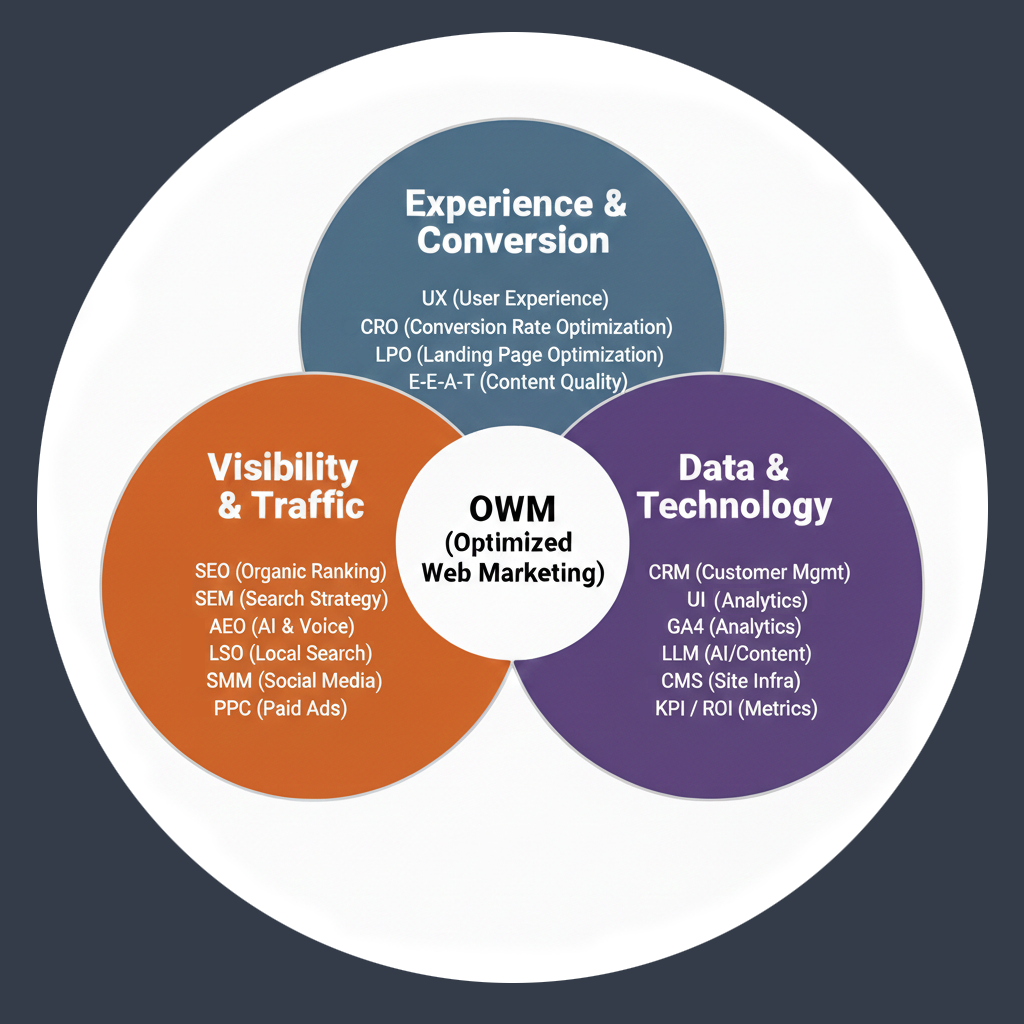
Contextual Disciplines
The OWM framework exists within an environment shaped by established, and emerging, digital disciplines. These are not necessarily part of the framework itself, but represent areas where optimization occurs:
Search & Discovery
SEO: Search Engine Optimization (Organic ranking).
SEM: Search Engine Marketing (The total search strategy).
AEO: Answer Engine Optimization (Optimizing for AI and voice answers like ChatGPT/Perplexity).
LSO: Local Search Optimization (Ranking for “near me” and Google Maps).
Paid Media & Acquisition
PPC: Pay-Per-Click (Paid ads on Google/Bing).
SMM: Social Media Marketing (Paid and organic social presence).
CPA: Cost Per Acquisition (Optimizing spend for specific results).
RTB: Real-Time Bidding (Programmatic display advertising).
User Experience & Conversion
UX: User Experience (How people feel/interact with the site).
UI: User Interface (The visual elements and layout).
CRO: Conversion Rate Optimization (Turning visitors into leads/sales).
LPO: Landing Page Optimization (Specific page-level performance).
Content & Engagement
LLM: Large Language Models (Leveraging AI for content generation and research).
CMS: Content Management System (The infrastructure of the site, like WordPress).
E-E-A-T: Experience, Expertise, Authoritativeness, and Trustworthiness (Google’s content quality framework).
Data & Relationship Management
CRM: Customer Relationship Management (Managing the leads OWM generates).
GA4: Google Analytics 4 (The primary data tracking tool).
KPI: Key Performance Indicators (The metrics used to measure OWM success).
ROI / ROAS: Return on Investment / Return on Ad Spend.
The OWM Framework
The framework centers on:
Structured knowledge and entity clarity
Cross-channel signal alignment
Continuous refinement through data
Authority development across platforms
Infrastructure that supports visibility
The Framework’s Foundation
Optimized Web Marketing is built on the understanding that visibility compounds when optimization is unified.
OWM does not replace existing disciplines.
OWM integrates established digital disciplines into a unified, holistic optimization framework that produces durable, compounding visibility.
You cannot have a high-performing OWM strategy without SEO, SEM, and UX.
But, using those disciplines individually will not achieve an “OWM-level” integrated result.
OWM provides a coordinated structure for understanding how they interact.
The framework is maintained as an evolving model to reflect changes in technology, platform behavior, and discovery systems.
Origin and Stewardship
Optimized Web Marketing™ (OWM™) was created by Lucas Arnatt, founder of BlindDrop Design Inc., as a structured response to the convergence of search engines, AI-driven interfaces, social platforms, and distributed media environments.
OWM is maintained independently as a strategic framework intended for open industry discussion and adoption. It is not positioned as a product, campaign, or software platform.
The intent of OWM is clarity, not ownership of the broader practice of digital marketing. The framework exists to articulate and organize the principles that govern modern web visibility.
Usage Guidelines
Optimized Web Marketing™ and OWM™ are protected designations.
Educational, analytical, and descriptive use of the framework is welcomed. Industry discussion and professional reference are encouraged.
Commercial use of the terms in a way that implies official affiliation, certification, endorsement, or proprietary ownership requires authorization.
The framework is open for learning and dialogue. The trademarks protect structured identity and representation.
OWM as a Living Framework
Web technologies continue to evolve. Artificial intelligence systems expand. Platforms shift. Discovery patterns adapt.
OWM is designed to remain structurally consistent even as specific tactics change. Its focus is not on individual tools, but on the enduring principle of coordinated optimization across systems.
Future updates to the framework will be documented and versioned to maintain transparency and continuity.
Contact
For collaboration, contribution, media inquiries, or framework-related discussion: